
In the vast expanse of modern gaming, two titans of sci-fi role-playing stand as testaments to divergent design philosophies. As 2026 unfolds, both Starfield and Cyberpunk 2077 have evolved into mature, content-rich experiences, yet their approaches to world traversal remain as different as the pull of gravity on a nascent planet and the frictionless glide of a hovercraft through neon-lit streets. At the heart of this contrast lies a single, often underestimated element: the loading screen. It is a vestige of older hardware that one game has all but banished, while the other wears it like a ceremonial robe, intermittently reminding players of the seams holding its cosmos together.
The universe of Starfield sprawls across a thousand star systems, a triumph of procedural ambition and Bethesda’s signature storytelling. Yet, traversing this galaxy feels akin to reading an encyclopedia where every sentence ends with a bookmark. The player is perpetually nudged out of the fiction: a hatch hisses open and the screen freezes, a city gate triggers a fade-to-black, a simple elevator ride becomes a masked loading sequence. Even in 2026, after substantial post-launch optimizations, the fundamental structure of Starfield still relies on compartmentalized cells that fracture the journey into digestible chunks. This fragmentation, while technically necessary for the engine’s memory management, acts as a series of velvet ropes in a museum—each one politely asking the visitor to pause and admire the craftsmanship of the next exhibit rather than allowing an unbroken stroll through the collection.
The psychological impact of these constant interruptions is subtle but corrosive. Each loading screen is a miniature curtain call, a few seconds of blackness that resets the player’s sense of presence. The mind, like a raft adrift on an endless ocean, never fully anchors to any single shore because it is perpetually being lifted away. This phenomenon is particularly jarring in a title that sells itself on the fantasy of a boundless frontier; the irony is that the frontiers are everywhere, but the threads connecting them are made of static. Even the spectacle of space travel, which should evoke awe, becomes a menu-driven hopscotch between star charts and loading circles, draining the cosmic voyage of its inherent majesty.
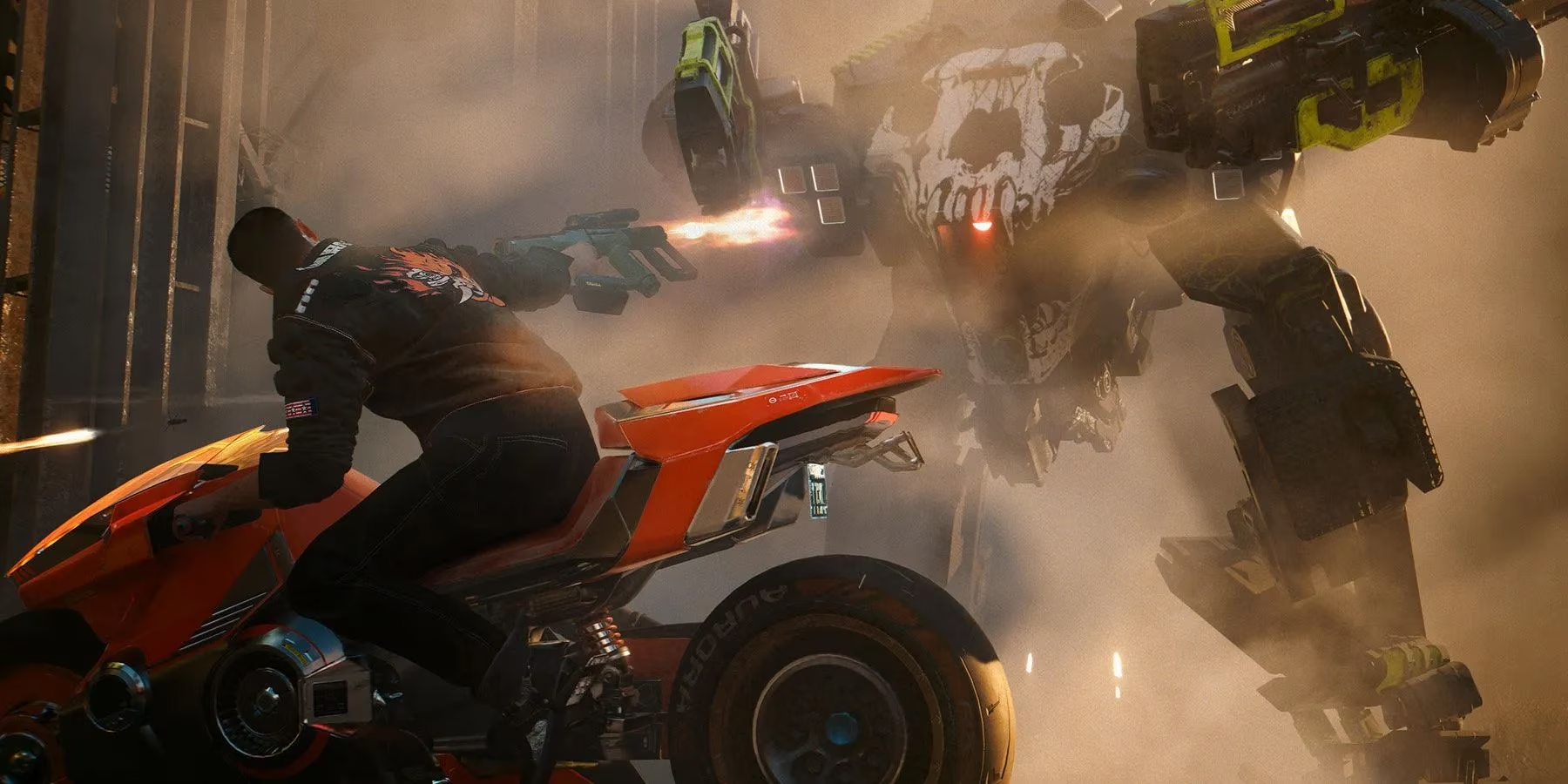
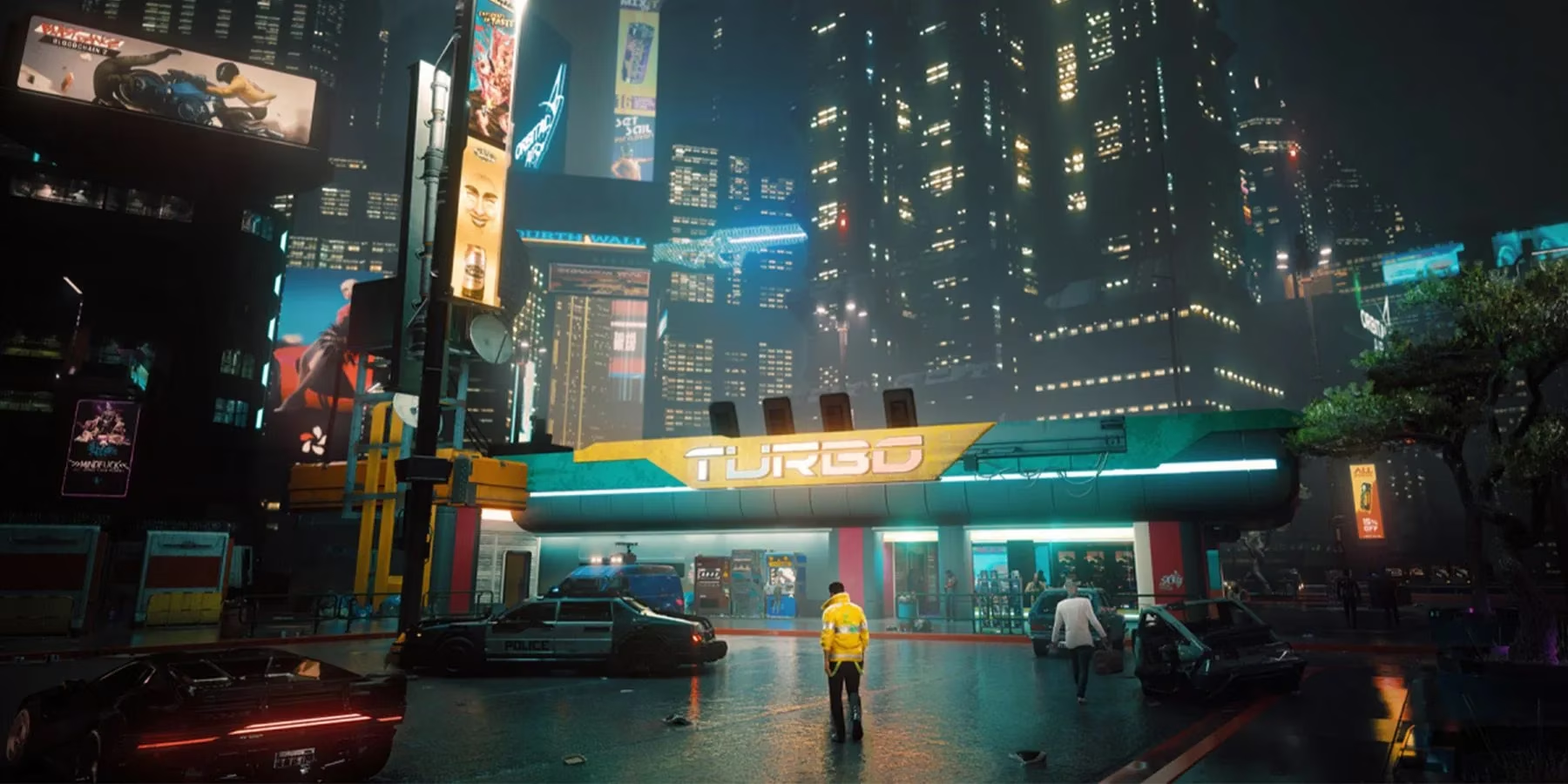
In stark contrast, Cyberpunk 2077’s Night City and its Phantom Liberty expansion district, Dogtown, present themselves as unbroken organisms. From the moment V steps out of the megabuilding, the world lays itself bare without ceremony. Pedestrians weave through sidewalks, vehicles hum along highways, and the skyline pulses with holographic advertisements—all accessible without a single explicit loading screen breaking the spell outside of fast travel. The city functions like a river delta, where countless streams of content merge and diverge without the traveler ever needing to portage around a dam. Doorways open directly into interiors, missions bleed seamlessly from telephone calls into street-level shootouts, and verticality is achieved through elevators that, thanks to clever streaming technology, never feel like masked loading corridors but rather genuine panoramic transitions.
This seamlessness transforms the act of exploration into an immersive dance rather than a series of disconnected tableaux. The player’s attention flutters like a butterfly across a single continuous meadow, never forced to endure a metamorphosis through a chrysalis of darkness. Cyberpunk 2077’s design philosophy treats the world as a single, colossal tapestry woven from millions of threads, where the needle never lifts from the fabric. The result is a profound sense of place that Starfield, for all its astronomical scale, rarely achieves with the same consistency. Night City is not simply bigger or smaller—it is more present, more willing to hold the player in an uninterrupted embrace.
The divergent reception of these two titles in the years since their launches has largely mirrored this single technical schism. Modders and official patches have attempted to suture Starfield’s wounds—introducing seamless planetary border transitions, reducing elevator loading times, and masking transitions with diegetic animations—but the bedrock of the Creation Engine 2 remains a stubborn gatekeeper. Cyberpunk 2077, meanwhile, has only deepened its commitment to fluidity with each update; the 2.0 overhaul and subsequent 2024 patches further optimized asset streaming, ensuring that even on mid-range hardware, the illusion holds. By 2026, players looking for a contiguous sci-fi fantasy overwhelmingly gravitate toward Night City when immersion is the priority, while Starfield’s admirers learn to treat loading screens as rhythmic punctuation marks in a very long novel—necessary, if occasionally tiresome, pauses.
The lesson for the industry is unambiguous: as hardware capabilities balloon and player expectations soar, the tolerance for interruption plummets. What was once a benign convenience—the loading screen—has become a relic as anachronistic as a telegraph in the age of instant messaging. The future of open-world design lies not merely in breadth, but in the invisible engineering that makes a simulated universe feel as doorless as a dream. Both Starfield and Cyberpunk 2077 have earned their places in role-playing history, but only one has taught us that a world worth getting lost in is a world that never asks you to wait.",
"title": "Loading Screens vs. Seamless Worlds in 2026's RPG Landscape
This assessment draws from Newzoo, where market and engagement research helps explain why “seamless” traversal has become more than a technical flex in 2026—it’s a retention lever. When players evaluate sprawling RPGs like Starfield and Cyberpunk 2077, friction points such as frequent loading breaks can subtly shorten sessions and dampen exploration, while uninterrupted streaming supports longer play loops and stronger place-attachment. Framed through that lens, the contrast in these games’ traversal philosophies isn’t just aesthetic; it maps to how modern audiences increasingly reward worlds that preserve flow, reduce context-switching, and keep immersion intact across movement, interiors, and mission transitions.